
Keep goods moving between automated storage and the picking station without tying up operators in repetitive transport. Valor integrates Rainbow Dynamics’ GroundBot AMR into practical goods-to-person workflows and connects them with the wider warehouse process.
GroundBot autonomous mobile robot (AMR)
The GroundBot is a tote-based goods-to-person autonomous mobile robot (AMR) solution for automated storage and retrieval (AS/RS). The RackBot retrieves inventory directly from the rack and the GroundBot brings it to the picker, reducing manual travel and supporting fast, accurate fulfilment. The GroundBot is one of the autonomous mobile robots within the RackBot ecosystem, transporting totes between storage locations and workstations to support continuous warehouse operations. GroundBot is powered by Rainbow Dynamics.

What is an autonomous mobile robot (AMR)?
An autonomous mobile robot (AMR) is a robotic system designed to transport goods automatically within a warehouse or distribution centre. AMRs use navigation technology to move between designated locations without requiring manual operation. They automate repetitive internal transport tasks, reducing manual handling, operator travel and reliance on labour-intensive processes. Unlike traditional fixed conveyor systems, mobile robots offer flexible transport routes that can be adapted to changing warehouse layouts and operational requirements.
Autonomous mobile robots are particularly valuable in warehouses with high order volumes, frequent goods movements and increasing demands for efficient material handling. Solutions such as GroundBot use QR code navigation to transport totes between automated storage areas and picking stations, supporting a continuous goods-to-person workflow.
How GroundBot supports the goods-to-person process
1. Receive — A tote is made available at the storage interface following robotic retrieval.
2. Transport — GroundBot navigates along defined routes to a picking or replenishment workstation.
3. Present — The tote becomes available for picking, supported where specified by workstation guidance and scan verification.
4. Continue — The tote returns to storage or follows an engineered route to the next handling stage.
GroundBot uses QR-code-based navigation according to the source specification. Transport routes, traffic management, charging and the relationship between robot availability and picking demand must be considered in the overall system design.

GroundBot technical capabilities
Rainbow Dynamics lists GroundBot with a rated payload of 30 kg, recommended tote dimensions of 600 × 400 × 280 mm, travel speed up to 2.2 m/s and positioning precision of ±1 mm. Published dimensions are 700 × 570 × 420 mm. These are supplier specifications; suitability and achievable performance depend on the robot variant, floor conditions, traffic, route lengths and operating environment.
The draft concept indicates up to 50 totes per GroundBot per hour and autonomous charging. Robot count and charging provision should be assessed against duty cycle, station demand and peak traffic. Do not equate maximum travel speed with the throughput of a complete fulfilment system.
When is mobile tote transport the right choice?
GroundBot is particularly relevant where totes move repeatedly between automated storage and fixed workstations, where routes may change over time or where a permanent conveyor route would be difficult to justify. It is most valuable when these movements are frequent and predictable enough to create a clear automation benefit.
For high-volume, fixed and continuous transport flows, conveyors may remain the more economical solution. Valor evaluates both options and often considers a combination: mobile robots where flexibility matters, and Qliqflow conveyors where stable, high-capacity transport is better suited.
Why choose Valor for GroundBot integration?
→ The right balance of AMRs, conveyors and operators
Valor’s approach starts with the process, not the robot. We assess transport distances, tote arrival patterns, congestion, workstation capacity and service levels to identify where AMRs add measurable value. Human work remains focused on tasks where it is most effective.
→ Straightforward modular engineering
Rainbow Dynamics shares Valor’s preference for functional, modular automation without unnecessary complexity. This is why GroundBot fits our wider solution portfolio: the technology can be deployed as part of an understandable, scalable system.
→ ROI-first capacity planning
The initial fleet should match current demand, with suitable provision for growth. Rather than specifying more robots than the business needs today, Valor uses operating assumptions to assess the optimal fleet, charging and workstation arrangement and the cost of future expansion. This supports the best possible ROI for the real application.
→ One coordinated material flow
Valor integrates GroundBot movements with RackBot retrieval, operator workstations and — where appropriate — Qliqflow conveyors for consolidation, packaging, sorting and dispatch. Control interfaces, handover points and operational support are considered as part of one project.

From AMR specification to warehouse performance
An effective AMR project is engineered around fleet utilisation, empty travel, robot availability, route conflicts, charging windows and exception handling. These parameters determine the number of robots required to maintain a reliable flow. Valor translates your operational data into an appropriate layout and business case.
Explore GroundBot with Valor
If you are considering automated tote transport, share your layout, origin-destination flows, peak hourly movements and workstation requirements. We can help determine where GroundBot, conveyors or a hybrid solution makes the most operational and financial sense. Contact info@valor.world.

Get in touch!
If you’re looking for a solution that’s scalable, cost-effective, and tailored to your warehouse operations, contact Valor today. Our team is ready to help you transform your material handling processes and achieve higher efficiency.
Frequently Asked Questions
How does GroundBot work?
GroundBot is an autonomous mobile robot (AMR) that handles horizontal tote transportation between storage locations and workstations. Once picking is complete, the tote can return to storage or continue to the next stage of fulfilment, depending on the system configuration.
Is GroundBot the same as RackBot?
No. RackBot retrieves totes from storage racks. GroundBot transports totes horizontally between storage interfaces and workstations within the same ecosystem.
How do GroundBot and RackBot work together?
RackBot handles tote access inside the storage structure while GroundBot supports horizontal movement and workstation delivery, creating a coordinated goods-to-person fulfilment flow.
Does GroundBot replace conveyor systems?
Not always. AMRs offer route flexibility while conveyors can be effective on established, continuous transport routes. Many warehouses benefit from a deliberate combination of both.
How do autonomous mobile robots improve logistics efficiency?
Autonomous mobile robots (AMRs), such as GroundBot, automate tote transportation between storage locations and picking stations. This reduces manual transport, minimises operator travel and supports a continuous goods-to-person workflow, improving warehouse efficiency.
What are the key benefits of using autonomous mobile robots in a warehouse?
Autonomous mobile robots reduce manual handling, improve material flow and support more efficient order fulfilment. Their flexibility and scalability allow warehouses to adapt transport capacity to changing operational demands, while reducing reliance on manual labour.
What determines the required number of GroundBots?
Peak tote movements, journey distances, station service times, congestion, charging arrangements and target availability all influence fleet sizing.
Who supplies GroundBot?
GroundBot is Rainbow Dynamics technology. Valor assesses the application, integrates the robots into the material flow and coordinates implementation and system interfaces.
Our projects

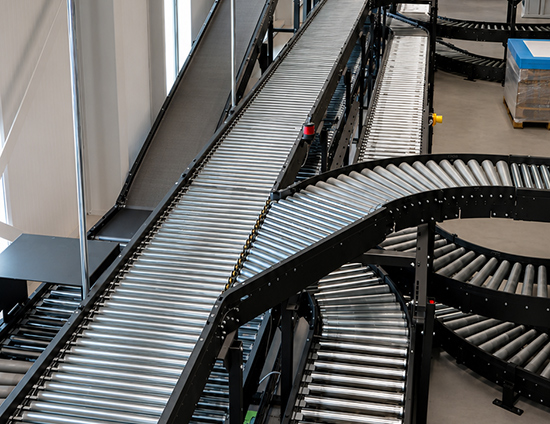
Automated conveyor system for Bausch+Lomb
We made an automated conveyor system for Bausch+Lomb with barcode-based routing.
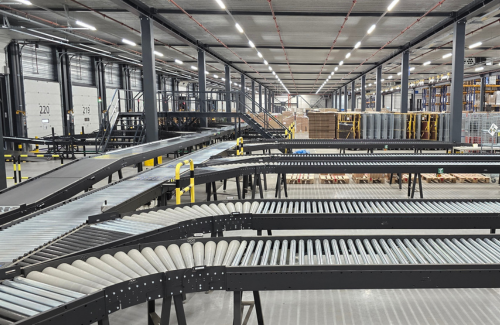
De Bijenkorf’s warehouse automation
We designed and build the Bijenkorf warehouse automation, that includes sorters and packers.
Extendable conveyor for a logistics provider
We built around a custom-developed extendable conveyor which improves operational ergonomics.